Korean Skincare Wholesale in the USA: 8 Questions to Ask a Supplier
Key takeaways
- Ask what documents come with every order, and whether you can verify them yourself.
- Minimums are usually set per brand, so a five-brand first order adds up fast.
- Landed cost, not unit price, decides your margin.
- In the US, any product sold with an SPF claim is regulated as an over-the-counter drug.
Most people who resell Korean skincare wholesale in the USA learn the expensive lesson on their second order, not their first. The first order is exciting. The second is when you work out what the first one actually cost.
If you're buying K-beauty wholesale for an Amazon listing, a Shopify store, an Instagram shop or a spa shelf, these are the questions worth asking any supplier before money moves. We wrote them from the buyer's side, including a couple that are awkward for suppliers like us.
1. Where does the stock come from, and what proves it?
Authenticity is the first thing your customers will question and the hardest thing to repair after a bad review. Ask how the supplier sources each brand and what paperwork travels with the order. At a minimum you want an invoice that matches the shipment, a Certificate of Authenticity and a Certificate of Origin, and you want to know whether those documents can be checked by someone other than the supplier.
Every Peacock order ships with its documents (invoice, Certificate of Authenticity, Certificate of Origin and MSDS), and you can check them on our document verification page.
2. What is the minimum, and is it per brand or per order?
In K-beauty wholesale, minimums are usually set per brand and by order value, not by units. On Peacock, each brand page lists its minimum: COSRX currently starts at $500 and TIRTIR at $800, for example.
That detail matters if you're planning a small mixed first order. Five brands at a $500 minimum each is a $2,500 commitment, not $500. Start with the one or two brands your customers already ask for by name, and add from there.
3. What will it cost to land, not just to buy?
The unit price is the number everyone compares. Landed cost is the number that decides your margin. Shipping, import duties, customs brokerage and payment fees all come off the top before you sell a single unit, and duty charges at the door are one of the most common surprises for new importers.
Ask whether prices are DDP (delivered duty paid, where the supplier covers duties and import fees to your address) or whether duties are yours on arrival. Peacock ships DDP to eligible countries, so the price you agree to is the price you pay. Ask whether your country is on the eligible list before you order. Then run the math at your real selling price, not the highest price you've seen a competitor list:
- Landed cost per unit = (product cost + shipping + duties + fees) ÷ number of units
- Margin = (your selling price − landed cost − marketplace fees) ÷ your selling price
If the margin only works at a price you've never actually sold at, the order is a bet, not a plan.
4. Are the labels ready for the US?
Cosmetics sold in the US need their required label information in English, and the FDA can refuse imports with labeling problems. Since December 29, 2024, US cosmetic labels also need a domestic address, phone number or electronic contact (such as a website) where customers can report problems.
Many Korean products come in more than one version: domestic Korean packaging, and a "global" or US version made for export. Ask which one you're getting. In our catalog, look for "Global Ver." or "US" in the product name, like the BANILA CO Clean it Zero balm listed as the US/ASEAN version.
5. Is anything in the order a drug in the US?
This is the one that catches resellers off guard. A product can be a cosmetic in Korea and a drug in the US. Sunscreen is the big example: in the US, anything sold with an SPF claim is regulated as an over-the-counter drug, and many Korean formulas use UV filters that aren't permitted here. The same goes for SPF cushions and foundations. Claims about treating a skin condition can also turn a cosmetic into a drug in the eyes of the FDA, and marketplaces are quicker to flag listings that read that way.
Ask your supplier which products in your order are the US-compliant versions, and look for a Drug Facts panel on anything with an SPF number.
6. How long is the lead time, really?
Ask for lead time per brand, and what it covers: dispatch from the warehouse, or delivery to your door. On Peacock, lead times are listed on each brand page, and most run 10 to 14 days. If you sell through Amazon FBA, add the time it takes for stock to be checked in at a fulfillment center before you plan a promotion around it.
7. Can products be matched to the listings you already sell?
If you sell on Amazon, matching new stock to existing ASINs saves hours of listing work and avoids duplicate listings. Ask whether the supplier shows ASINs or UPCs. Peacock's catalog can be searched by ASIN, UPC or product name.
8. What happens if something arrives wrong?
Ask before your first order, not after. How many days do you have to report damage or a shortage? What photos do they need? Do they replace the item, credit your account or refund? Get the answer in writing. How a supplier handles a broken box tells you more than any sales page.
Your pre-order checklist
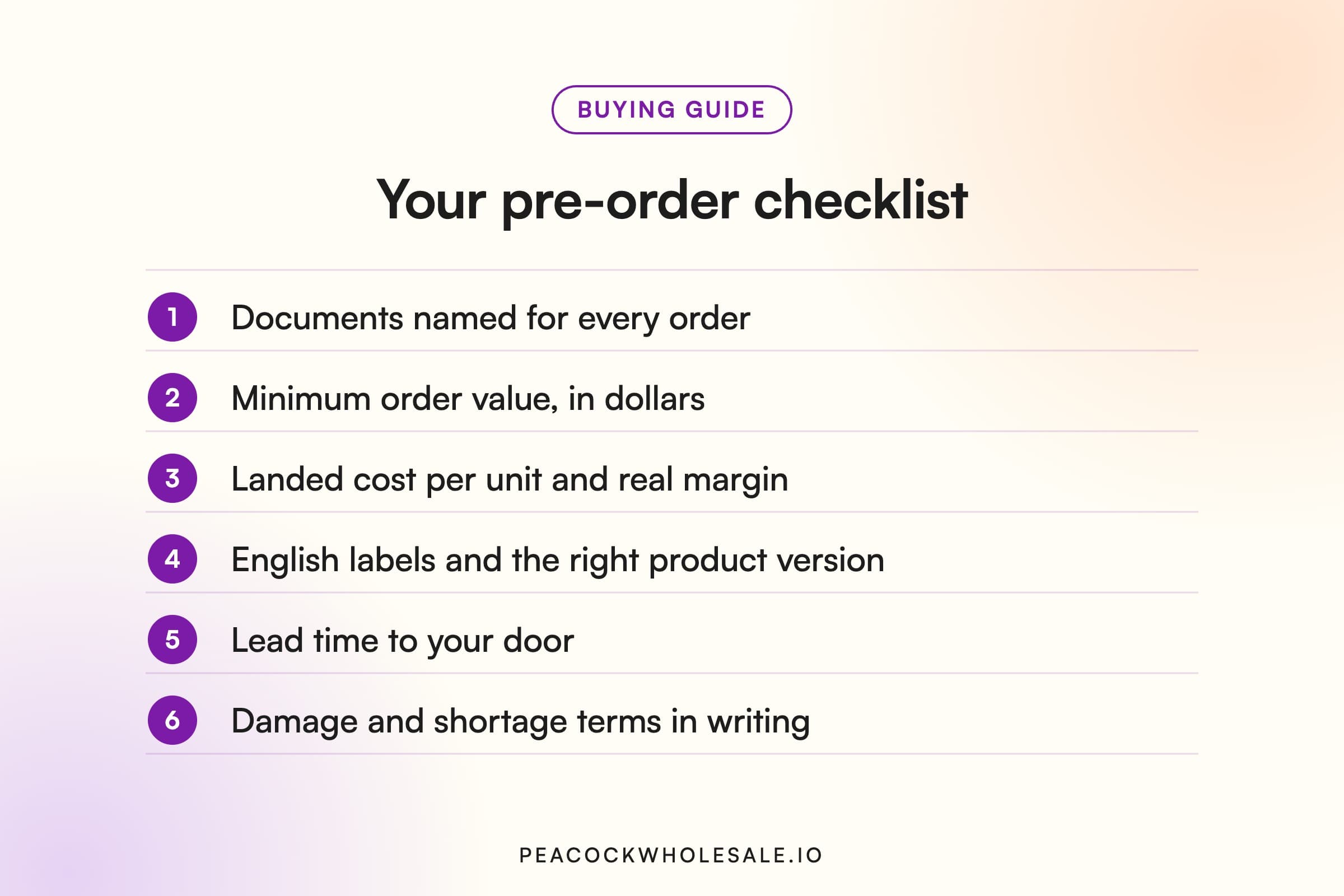
- Documents named for every order: invoice, Certificate of Authenticity, Certificate of Origin, MSDS
- Minimum per brand, in dollars
- Landed cost per unit, and margin at your real selling price
- English labels with a US contact, or the US/global version confirmed
- No SPF products unless they're the US version with Drug Facts
- Lead time to your door, plus FBA check-in time if relevant
- ASIN or UPC match for each product
- Damage and shortage terms in writing
Want to see minimums and lead times brand by brand? Browse the brands, or read our buying guide to see how ordering works.
Questions readers ask

Mia writes Peacock's brand profiles and buyer guides, with a background in life science and a focus on making K-beauty sourcing clear for resellers.
Published Oct 19, 2026 · Updated Oct 21, 2026
SIGN UP FOR OUR NEWSLETTERS
GET NOTIFIED OF THE BEST DEALS ON OUR WORDPRESS THEMES.